

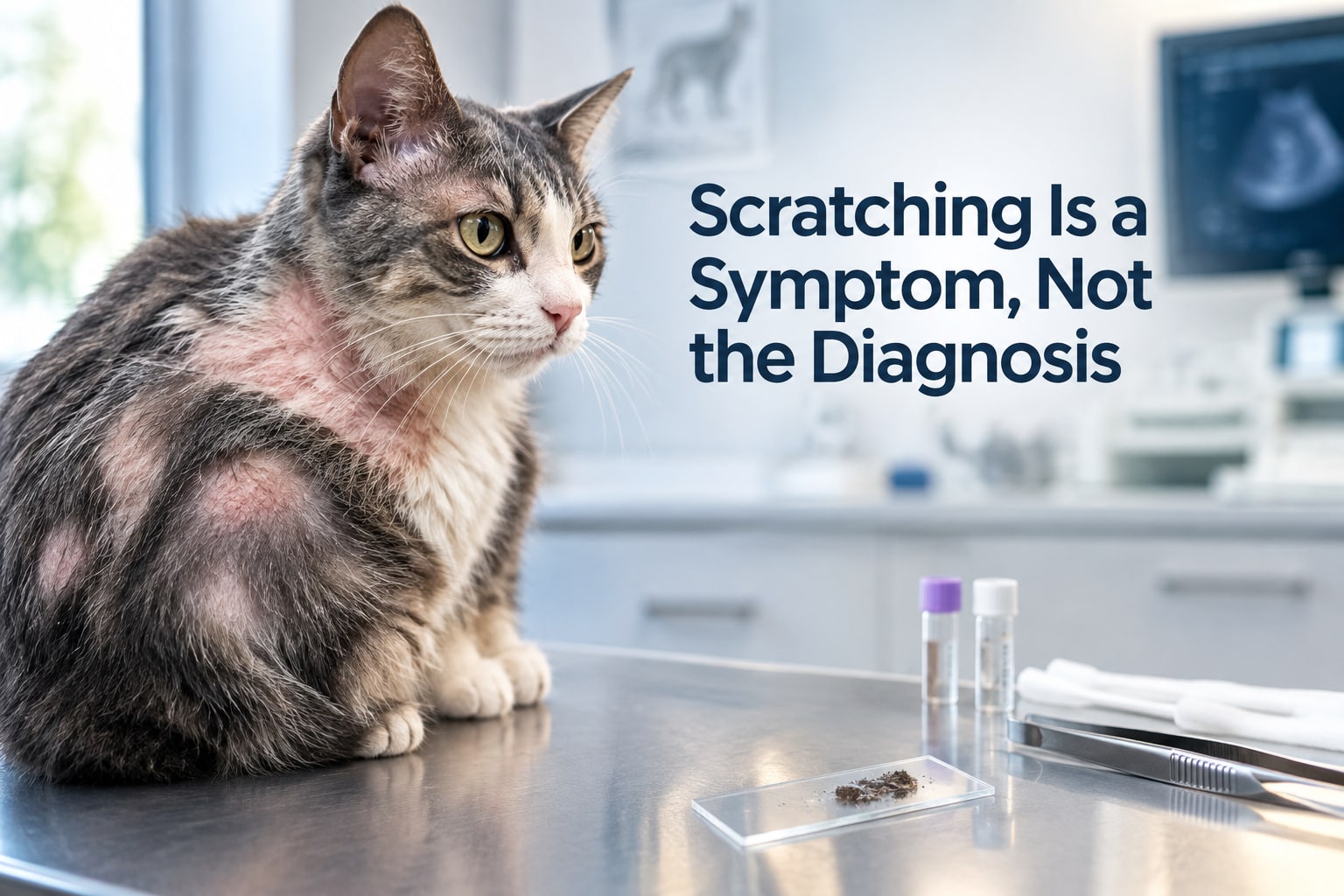
A cat that scratches, licks, or chews until its coat thins may have fleas, infection, allergy, pain, parasites, or an internal disease—not a cosmetic coat problem. You will learn how lesion patterns guide the next step, which warning signs need prompt care, what to document before an appointment, and why treatment must match the cause.
Key takeaways
- Check for fleas, flea dirt, ear debris, wounds, scabs, and ring-shaped bald patches.
- Seek prompt veterinary care for spreading wounds, pus, severe itching, pain, or reduced appetite.
- Expect diagnosis to involve skin examination, flea control review, and tests such as skin scrapings.
- Treatment depends on the cause and may include parasite control, antifungals, antibiotics, or allergy management.
What causes a cat to scratch, lick, and lose hair?
Fleas and flea-allergy dermatitis are common cat excessive scratching causes, but ear mites, ringworm, bacterial or yeast infection, food allergy, environmental allergy, pain, stress, and hormonal disease can look similar.
A scratching cat usually breaks hairs and creates scabs or raw marks; a cat with cat overgrooming and hair loss often leaves smooth, symmetrical bald areas while the skin initially looks nearly normal.
- Examine the location: a bald belly in cats, hair loss on the sides, tail-base irritation, or scabs around the neck can point toward allergy or fleas; ear scratching and dark ear debris suggest ear mites; circular bald patches with scaling raise concern for ringworm.
- Check the skin: redness, crusts, oozing, odor, thickening, and small bumps suggest inflammation or infection, while normal-looking skin beneath a clipped-looking coat suggests licking or chewing. Pain from a joint, abdomen, or wound can cause focused licking.
- Review triggers: stress can cause overgrooming, but do not call it behavioral until parasites, allergy, infection, pain, and hormonal disease have been investigated.
These patterns provide clues, not a diagnosis. Cats often groom fleas away, so finding no flea does not rule out flea allergy; one bite can trigger intense itching in a sensitive cat. Ringworm is contagious to people and animals, unlike allergy and stress overgrooming, which are not contagious.
Common cat hair loss causes overlap, so persistent scratching needs veterinary examination.
Which skin symptoms need prompt veterinary care, and what should you check first?
Open wounds, pus, marked pain, facial swelling, breathing difficulty, lethargy, fever, rapidly spreading lesions, or a cat that stops eating make home observation unsafe. Facial swelling with breathing trouble is an emergency; contact a veterinarian immediately.
Before the appointment, check and record:
- Flea dirt on cats, live fleas, and dark debris in the ears
- New food, treats, litter, cleaners, medications, or insect-control products
- Whether another household animal has itching, hair loss, or skin lesions
- When the hair loss began and whether it is spreading
- Photos of the coat and lesions, itch intensity, appetite, medication doses, and the dates of each response
Bring medication packaging, plus vaccination and parasite-prevention records. This is what to bring to a veterinary appointment when the diagnosis or product history is unclear.
| Sign | Action | Why it matters |
|---|---|---|
| Open wound or pus | Seek prompt care | Damaged skin can become infected |
| Facial swelling or breathing difficulty | Seek emergency advice | An allergic reaction can threaten the airway |
| Lethargy, fever, or stopped eating | Arrange prompt assessment | Illness may extend beyond the skin |
| Rapidly spreading lesions or severe pain | Do not wait for home treatment | Infection or another urgent disease may be progressing |
Do not shave an irritated cat or force off scabs. Avoid essential oils, household antiseptics, human creams, and insecticides. Dog-only or human products containing permethrin can cause permethrin toxicity in cats; suspected poisoning requires urgent veterinary advice.
How does a veterinarian find the actual cause?
Internet photographs cannot show lesion texture, parasites, infection, or pain, so copying a guessed treatment can mask the original problem. Repeatedly changing over-the-counter products can irritate skin, create adverse effects, and delay relief. A cat skin examination covers the skin, coat, ears, mouth, body condition, and possible musculoskeletal, abdominal, urinary, or neurologic sources of pain.
The veterinarian chooses tests for specific suspects rather than ordering interchangeable checks:
- Flea combing for cats looks for live fleas and flea dirt, even when grooming has removed visible fleas.
- A cat skin scraping or another parasite test investigates mites.
- Cytology examines skin or ear material for bacteria and yeast; these infections can result from self-trauma rather than cause it.
- For suspected ringworm, a Wood's lamp, microscopic examination, fungal culture, or PCR may be combined. A Wood's lamp alone misses some infections.
Blood tests become relevant when weight loss, increased thirst, increased urination, symmetrical coat loss, age, or other findings point toward hormonal or systemic disease. Food allergy is not confirmed reliably by a blood test; it requires a strict, veterinarian-designed elimination diet followed by a controlled challenge.
Treats, flavored medicines, hunting, or another pet’s bowl can invalidate the trial. Environmental allergy is considered after parasites, infection, and food allergy have been addressed.
Which cat skin treatment fits each diagnosis?
A treatment that calms scratching is not necessarily treating the cause. Match the plan to the diagnosis:
| Treatment | What it addresses | What correct use involves |
|---|---|---|
| Cat flea treatment | Fleas and flea-allergy dermatitis | Treat every cat and dog, plus bedding, floors, and resting areas; missed immature fleas can cause apparent failure |
| Antiparasitic medicine | Mites | Use the product and repeat schedule prescribed for the identified mite |
| Antibiotics | Confirmed bacterial infection | Complete the course; infection may return if allergy, fleas, or self-trauma remains |
| Antifungal medicine and cleaning | Ringworm | Follow the cat ringworm treatment plan and clean contaminated bedding, carriers, and grooming tools |
| Corticosteroids or other anti-itch medicine | Vet-confirmed inflammation or allergy | Use only at the prescribed dose and duration |
| Medicated shampoo for cats | Selected surface infection or inflammation | Leave it on for the prescribed contact time, then rinse thoroughly |
| Exclusive prescribed diet | Suspected food allergy | Feed only the trial diet for the full period, then follow the controlled challenge |
A cat allergy treatment can fail when fleas, infection, or the food trigger remains. Steroids can mask or worsen infection and carry added risks for cats with diabetes, kidney disease, pregnancy, frailty, or interacting medicines.
During a diet trial, give no treats, flavored medicines, table food, hunting opportunities, or access to another pet’s bowl. Tell the veterinarian if oral medicine is refused so the plan can change safely. Pet Care Hospital- Best Pet Clinic in Dwarka can coordinate examination, testing, instructions, and monitoring rather than another untested product.
Finish every prescribed course.
Related service
Veterinary Dermatology & Skin Care Veterinary Dermatology & Skin Care At Pet Care Hospital with Dr. Satish, veterinary dermatology focuses on keeping your pet’s skin and coat healthy, comfortable, and free from... View service → |
How long should recovery take, and when does a cat need follow-up?
Reduced scratching is usually the first visible sign that treatment is working. Cat hair regrowth after treatment takes longer because each coat must complete its growth cycle, and continued licking can stop new hair from appearing. Judge progress against the timeframe your veterinarian gave for the diagnosis, not against the bald area alone.
Arrange cat skin treatment follow-up if:
- Itching or licking has not improved within that timeframe.
- Hair loss remains unchanged, lesions spread, or wounds and crusts worsen.
- Signs return after treatment ends.
- New areas become bald, scaly, painful, or infected.
Persistent lesions can mean treatment failure, reinfestation, an incorrect diagnosis, or chronic allergy that needs ongoing trigger control rather than a one-time cure. Recheck testing may include skin cytology or scrapings, an ear examination, or fungal culture or PCR.
For ringworm, isolate your cat as directed, clean contaminated bedding and grooming tools, and protect people and other animals from exposure. Ringworm cleaning for cats must continue with the treatment plan.
For fleas, treat every cat and dog in the household and use flea control in the home; eggs and immature stages remain in bedding, carpets, and other surroundings, so treating only the itchy cat can look like treatment failure.
Keep dated photographs and follow prevention instructions. If signs recur, schedule reassessment instead of restarting leftover medication.
Frequently asked questions
What causes a cat to scratch, lick, and lose hair?
Common causes include fleas and flea-allergy dermatitis, ear mites, ringworm, bacterial or yeast infection, food or environmental allergy, pain, stress, and hormonal disease.
Which cat skin symptoms need prompt veterinary care?
Arrange prompt veterinary care for spreading hair loss, open wounds, pus, severe redness, painful skin, intense itching, circular bald patches, or reduced appetite.
How does a veterinarian find the cause of cat skin irritation?
A veterinarian reviews the history, examines the skin and ears, checks parasite control, and may use skin scrapings, cytology, fungal testing, blood tests, or a diet trial.
Which cat skin treatment fits each diagnosis?
Flea-related disease requires effective parasite control; ringworm needs antifungal treatment and environmental cleaning; infections need targeted medication; allergies require trigger control and veterinary-directed itch management.
How long should cat skin treatment take, and when is follow-up needed?
Itching can improve before hair regrows, while ringworm and infections need longer treatment. Schedule follow-up if symptoms worsen, new lesions appear, or recovery stalls.