

Recurring itching does not automatically mean environmental allergy: fleas, mites, infections, fungal disease, contact irritation, pain, and behavioural licking can produce overlapping signs, and more than one problem can exist at once. You will learn how a dermatologist builds the diagnosis, chooses tests, interprets common findings, and confirms whether allergy is truly driving the cycle.
Key takeaways
- Map where your pet itches before the appointment.
- Ask for skin cytology when infection is suspected.
- Use strict flea control before testing environmental allergy.
- Confirm food allergy with an elimination diet and reintroduction.
How the dermatologist separates allergy from other causes of itching
Recurring itching in pets does not automatically mean environmental allergy. The dermatologist studies where the pet scratches, licks, or loses hair, whether the problem follows seasons, and whether other animals or people itch. Allergy, fleas, mites, infection, pain, and compulsive licking can overlap, so one clue rarely settles the diagnosis.
| Clue | More suggestive of | Important limitation |
|---|---|---|
| Tail base, rump, and hind legs; intense sudden itch | Flea allergy dermatitis | Finding no flea does not exclude it; one bite can trigger severe itching. Check every in-contact animal and maintain consistent flea control. |
| Ear edges, face, elbows, feet, or belly with crusts or hair loss | Mites in dogs and cats | Distribution alone cannot identify the mite; contagious sarcoptic mange can cause intense itch. |
| Greasy coat, odour, redness, pustules, or moist sores | A bacterial skin infection pets develop, or yeast overgrowth | Infection can be secondary to allergy, so treating microbes alone may not stop recurrence. |
| One painful spot, reluctance to move, or guarding when touched | Pain, injury, or an underlying lump | Licking may target the painful area rather than reflect itch. |
| Licking during boredom, anxiety, or when unsupervised, with a sharply localised bald patch | Behavioural licking | Rule out allergy, parasites, infection, and pain before calling it behavioural. |
A dermatologist also checks ears: allergic inflammation can produce recurrent bacterial or yeast otitis. Ringworm often causes circular hair loss and scaling with less dramatic itch, while allergy more often affects multiple areas and relapses. Flea-comb examination, cytology, scrapings, and hair examination then test these initial impressions.
The history and examination that come before laboratory tests
Seasonality, body distribution, and treatment response give the veterinarian the first map of the problem. During the pet allergy history, expect questions about age at onset, itchy months, diet and treats, outdoor exposure, household cleaners, shampoos, previous medicines, and whether other pets or people itch.
The veterinarian also records flea prevention, missed doses, and whether itching returns after antibiotics, antifungal treatment, or steroids.
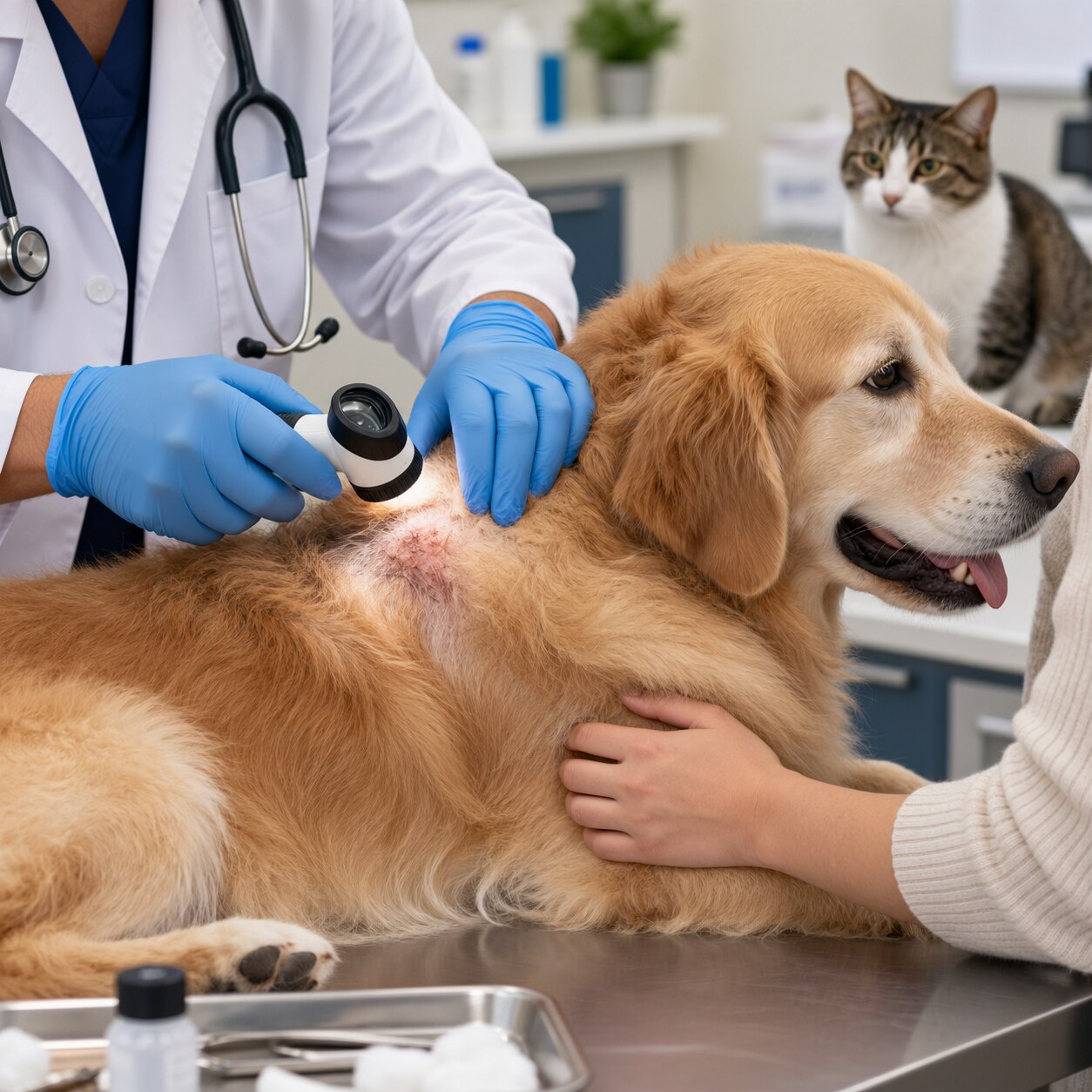
The pet dermatology examination covers the entire skin, not only the sore area. The veterinarian checks the face, lips, paws, nail beds, groin, armpits, belly, tail base, and skin folds for redness, scaling, hair loss, crusts, odour, thickening, and darkening.
Paw licking and facial rubbing point to distribution and discomfort, but they do not identify the trigger.
Ear disease belongs in the same assessment. Recurrent ear infections require an otoscopic examination for canal narrowing, discharge, foreign material, and a damaged eardrum; the findings determine whether ear cytology is needed rather than another empirical drop.
- Flea dirt or live fleas directs a flea-control review, even when the examination finds no flea.
- Crusts, hair loss, or intense focal itch directs skin scrapings or hair examination for mites.
- Greasy scale, odour, pustules, or moist lesions directs cytology for yeast or bacteria.
- Persistent, atypical, or poorly responsive disease directs fungal testing, culture, or biopsy after the examination identifies the best lesion to sample.
These findings shape the work-up before allergy testing, because allergic skin disease is diagnosed after parasites and infection have been addressed.
What skin cytology, scrapings, cultures, and biopsies reveal
Skin cytology for pets reveals Malassezia yeast, cocci, rod-shaped bacteria, inflammatory cells, and sometimes cancer cells. A swab or tape strip from an active lesion is examined under a microscope; appearance alone cannot reliably distinguish allergic inflammation from secondary infection. Ear cytology is equally important when otitis, head shaking, or recurrent ear discharge occurs.
| Test | What it reveals | When it is appropriate |
|---|---|---|
| Skin cytology | Yeast, cocci, rods, inflammation | Crusts, greasy skin, pustules, odour, or suspected infection |
| Ear cytology | Malassezia, bacteria, inflammatory cells | Any recurrent or painful ear infection before repeating drops |
| Skin scraping mites | Demodex or Sarcoptes mites and eggs | Severe itch, hair loss, scaling, or poor response to allergy treatment |
| Bacterial culture and susceptibility | The organism and antibiotics likely to work | Deep infection, rod-shaped bacteria, treatment failure, or recurrent pyoderma |
| Fungal culture pets | Dermatophytes such as ringworm | Circular hair loss, broken hairs, scale, infected household members, or exposure risk |
| Biopsy | Immune-mediated, hormonal, neoplastic, or other unusual disease | Atypical lesions, ulcers, nodules, persistent disease, or failed standard treatment |
For suspected resistant infection, collect culture from an intact pustule or deeper lesion before changing antibiotics. A swab from an ulcerated, heavily contaminated surface can identify the wrong organism. Localised superficial infection often needs topical treatment rather than an automatic systemic antibiotic.
A biopsy removes a small section of skin for histopathology; it does not replace cytology or scraping when infection or mites are likely. A negative scraping also does not end the investigation if the clinical pattern remains suspicious.
How environmental, food, flea, and contact allergies are confirmed
A pattern raises suspicion; it does not confirm the trigger. The dermatologist compares seasonality, body distribution, exposure history, flea control, and response to treatment, while excluding mites, infection, and other causes. Canine atopic dermatitis has no definitive laboratory test, and Favrot criteria support recognition rather than replace that process.
| Trigger | Pattern that raises suspicion | How confirmation is approached |
|---|---|---|
| Environmental allergies in dogs | Seasonal or year-round itching affecting paws, face, ears, armpits, and abdomen | Diagnose by exclusion; intradermal or serum testing helps select allergens for immunotherapy, not prove the cause |
| Food allergy | Nonseasonal itching, recurrent ears or feet, or gastrointestinal signs | Feed one novel-protein or hydrolyzed diet exclusively for about 8 weeks, then perform a controlled rechallenge |
| Flea allergy dermatitis | Intense itch around the lower back, tail base, and thighs, even without visible fleas | Use consistent flea control on every in-contact animal and reassess the response |
| Contact dermatitis pets develop | Irritation limited to areas touching a floor cleaner, bedding, plant, or topical product | Remove the suspected contact and observe whether the same reaction returns after re-exposure |
The food allergy elimination trial pets undergo fails if treats, table food, flavoured medicines, supplements, or another animal’s bowl slips in. A positive blood or skin result in allergy testing dogs shows sensitisation, not necessarily itchy disease.
Contact dermatitis pets develop also lacks a dependable routine blood test, so exposure history and controlled avoidance carry more weight.
What happens when infections and itching keep returning
If a skin infection returns soon after treatment, the infection may be the amplifier, not the root cause. Repeat short courses without investigating the trigger can select resistant bacteria, damage the skin barrier, and leave allergic inflammation untreated.
A durable allergy management plan for dogs and cats is tailored to the pattern of disease and may combine:
- Year-round flea control for every dog and cat in contact, because one bite can trigger intense itching in a sensitised pet even when no flea is found.
- Treatment of active yeast or bacterial infection, using topical therapy for many localised superficial infections rather than automatically prescribing oral antibiotics.
- Bathing, moisturising, and other barrier-care measures to reduce irritant exposure.
- Anti-inflammatory or antipruritic treatment, with trigger avoidance when a specific food or contact irritant is identified.
- Reassessment when lesions, itch, or ear discharge return.
Seek a veterinary dermatologist consultation when flares recur, several treatments have failed, infections involve the ears repeatedly, or itching continues between infections. The work-up may investigate parasites, endocrine disease, medication exposure, immune dysfunction, or an anatomical problem. Deep infection, rod-shaped bacteria on cytology, recurrence, or treatment failure can justify culture and antibiotic sensitivity testing.
Pet Care Hospital- Best Pet Clinic in Dwarka can help organise follow-up around response, relapse timing, ear findings, and test results rather than treating each flare as an isolated infection.
Related service
Veterinary Dermatology & Skin Care Veterinary Dermatology & Skin Care At Pet Care Hospital with Dr. Satish, veterinary dermatology focuses on keeping your pet’s skin and coat healthy, comfortable, and free from... View service → |
Frequently asked questions
How does a pet dermatologist distinguish allergy from other causes of itching?
The dermatologist assesses itch location, hair loss, seasonality, exposure to fleas or mites, infection signs, pain, and compulsive licking before choosing tests.
What happens before laboratory tests for recurring skin problems?
The veterinarian takes a detailed history and performs a full skin examination, including lesion location, affected body areas, parasites, odour, redness, and secondary infections.
What do skin cytology, scrapings, cultures, and biopsies reveal?
Cytology identifies yeast, bacteria, and inflammatory cells; scrapings look for mites; cultures assess selected bacterial or fungal infections; biopsies examine tissue changes.
How are environmental, food, flea, and contact allergies confirmed?
Flea allergy is assessed through strict parasite control, food allergy through an elimination diet followed by reintroduction, and environmental or contact allergy after other causes are investigated.