

A seizure lasting more than five minutes, repeated seizures without recovery, sudden paralysis, or an inability to stand needs emergency care rather than a routine appointment. By the end, you will know which signs require immediate hospital treatment, what to record at home, and when a neurologist should investigate seizures, weakness, or balance loss.
Key takeaways
- Treat seizures lasting over five minutes as an emergency.
- Record duration, movements, awareness, triggers, and recovery after every episode.
- Seek urgent assessment for sudden weakness, collapse, head tilt, or repeated falls.
- Ask about referral, MRI, spinal-fluid testing, and treatment goals when episodes recur.
When a Seizure Is an Emergency
A seizure lasting more than five minutes is a pet seizure emergency: go to an emergency hospital, not a routine appointment. Repeated seizures without the pet returning to normal awareness indicate status epilepticus and require immediate treatment. Do not wait for a neurology referral.
| Sign | Why it is urgent | Action |
|---|---|---|
| Seizure lasting more than five minutes | Prolonged seizure activity can threaten breathing and body temperature | Leave for an emergency hospital immediately |
| Cluster seizures | Multiple seizures in 24 hours can progress to continuous seizure activity | Seek emergency assessment the same day |
| Repeated seizures without recovery | This is consistent with status epilepticus | Treat as an emergency, even if each seizure appears brief |
| Trouble breathing, blue or pale gums | Oxygen failure can become life-threatening | Go directly to emergency care |
| Collapse or failure to regain normal awareness | Persistent abnormal mentation may signal ongoing brain dysfunction | Do not wait for the pet to recover at home |
| Possible poisoning or severe head trauma | Toxins and injury can cause seizures and require urgent treatment | Tell the hospital what was ingested or what happened |
Keep the pet away from stairs and hard objects while arranging transport. Do not put fingers or objects in the mouth or restrain the body; time the episode and record video only if doing so is safe.
What to Do During a Seizure and What to Record
Keep your pet on the floor and move furniture, stairs, and other animals away. What to do during a pet seizure is protect against injury, not restrain the body. Do not put fingers, food, water, or objects in the mouth; your pet cannot swallow the tongue, but may bite involuntarily.
Start a clock when the event begins. Record a seizure video from a safe distance if you can, showing the whole body and face without trying to interrupt the episode. Seek emergency care for a seizure lasting more than five minutes or repeated seizures without a return to normal awareness.
- Note what your pet was doing immediately beforehand: sleeping, eating, exercising, waking, or resting.
- Record whether awareness appeared lost, and whether the eyes, face, limbs, or one side moved abnormally.
- Write down urination, defecation, vocalisation, collapse, and any possible toxin, medication, or head-injury exposure.
- Record the pet seizure duration with a clock, how many events occurred, and whether anything interrupted it.
- Measure the postictal period: note confusion, blindness, circling, sleepiness, weakness, hunger, or unusual behaviour, and when normal awareness returned.
Give the video and timeline to your veterinarian or neurologist; fainting, vestibular episodes, sleep movements, and seizures can look similar at home.
How to Tell a Seizure From Fainting or Another Episode
Loss of consciousness is the key dividing line in fainting versus seizure, but the episode’s timing and recovery matter too. Syncope in pets usually follows exertion, coughing, or excitement; the pet goes limp, collapses briefly, and returns to normal quickly without a confused recovery period.
1. A generalized seizure in dogs commonly causes sudden loss of awareness, stiffening followed by rhythmic paddling, jaw movements, drooling, urination, or defecation. Confusion, pacing, temporary blindness, or sleepiness can last minutes to hours afterward.
A focal seizure may preserve awareness and appear as facial twitching, repeated lip-licking, snapping at invisible objects, or jerking of one limb; it can spread into a generalized seizure.
2. Vestibular disease causes a persistent head tilt, falling, circling, jerky eye movements, or nausea rather than a brief event with a clear recovery. Tremors usually produce rhythmic shaking while awareness remains intact. Pain causes guarding, crying, or reluctance to move, not stereotyped paddling and post-event confusion.
3. Narcolepsy causes sudden muscle weakness triggered by excitement or eating, with rapid recovery and no postictal phase. A behavioral event is usually interruptible and linked to a recognizable trigger. Record video, duration by clock, awareness, movements, and recovery; these details separate look-alike episodes.
When Weakness or Balance Loss Needs Urgent Neurologic Assessment
Sudden weakness, inability to stand, or rapidly worsening balance loss needs urgent neurologic assessment, not a routine check-up. The word “weakness” describes an observed problem, so examination must distinguish brain, spinal cord, nerve, neuromuscular, muscle, pain, metabolic, and heart or lung causes.
Seek same-day assessment for these pet weakness warning signs:
- dragging toes, knuckling, stumbling, or crossing the limbs
- collapse, inability to rise, or weakness that spreads
- new asymmetric postural reactions, marked disorientation, blindness, or reduced awareness
- head tilt and circling in dogs, especially with vomiting, abnormal eye movements, or inability to walk
- vertical nystagmus, direction-changing nystagmus, or balance loss combined with limb weakness
| Change | Why it matters | Best first step |
|---|---|---|
| Sudden or progressive weakness | A spinal cord, brainstem, nerve, or neuromuscular problem can worsen quickly | Emergency or urgent neurologic assessment |
| Head tilt alone with steady improvement | Acute peripheral vestibular syndrome often improves within days, with major recovery over weeks | Veterinary examination, then monitoring if confirmed |
| Balance loss with altered mentation or postural deficits | These signs point beyond an uncomplicated inner-ear episode | Urgent neurologic assessment |
Do not begin rehabilitation while weakness is progressing, your pet cannot walk safely, or the lesion has not been localized. Exercise can cause falls and delay treatment of compression, inflammation, toxin exposure, or metabolic disease. A stable, improving patient can enter rehabilitation after veterinary examination and a safety plan.
When a Neurologist Referral and Advanced Testing Make Sense
Referral is warranted when seizures begin before about 6 months or after about 6 years, the episodes cluster, remain poorly controlled with medication, or the neurologic examination stays abnormal between events. Ask when to see a veterinary neurologist if you notice:
- Circling, altered awareness, vision loss, head tilt, or unequal postural reactions
- Progressive weakness, repeated falls, or worsening balance
- Seizures despite appropriate treatment or troubling medication effects
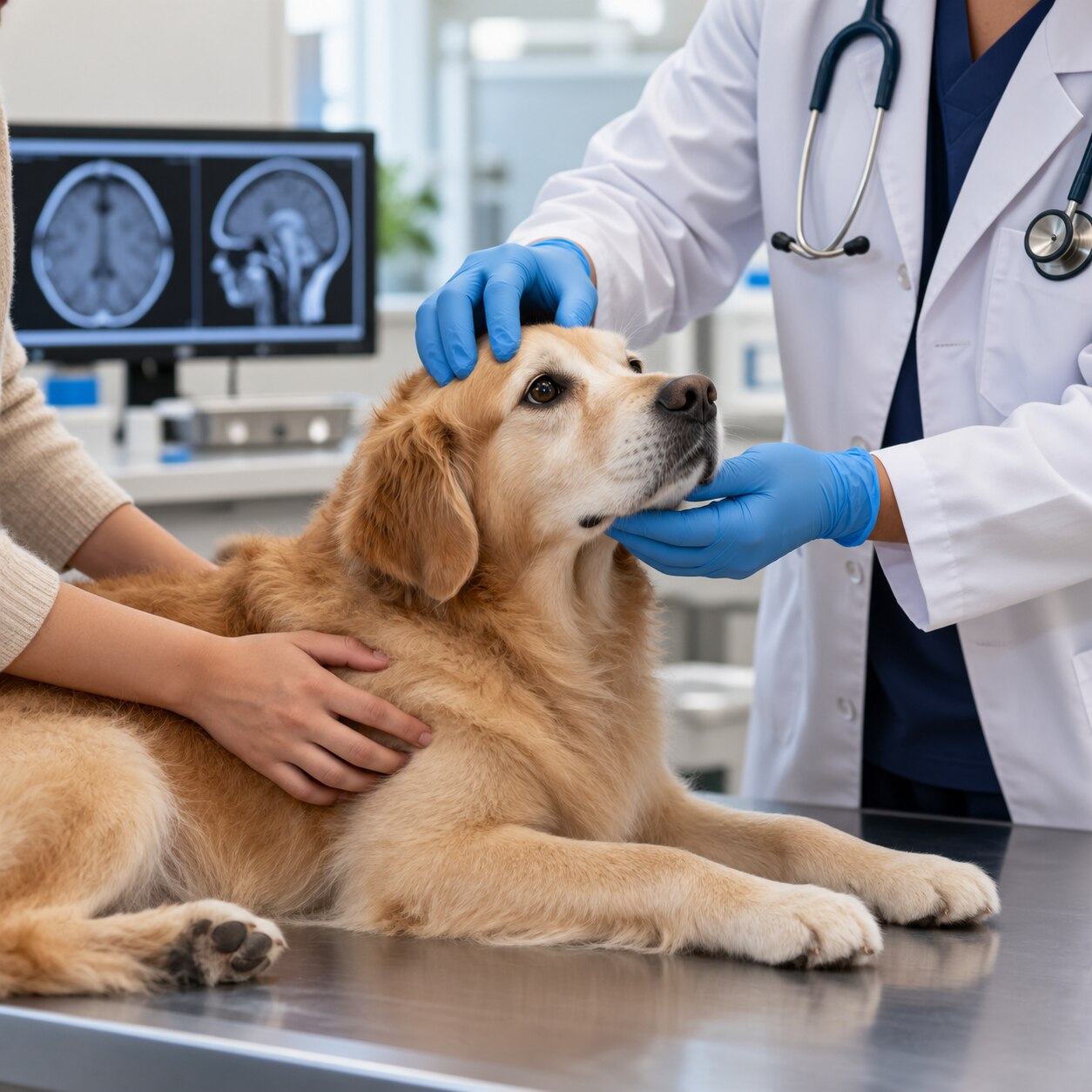
Many dogs with idiopathic epilepsy have a normal examination between seizures, so a normal result does not rule out epilepsy. The examination instead helps localize the problem to the brain, spinal cord, nerves, or muscles and determines whether advanced investigation is justified.
Laboratory tests assess blood glucose, electrolytes, liver and kidney function, blood-cell changes, infection, toxin exposure, and medication safety. They can reveal a seizure trigger outside the brain, but they cannot exclude every structural disease.
The CT versus MRI veterinary neurology choice depends on the question:
| Test | Best at showing | Main limitation |
|---|---|---|
| MRI | Brain, spinal cord, inflammation, tumors, and other soft-tissue lesions | Slower and often requires anesthesia |
| CT | Bone, skull injury, and some middle-ear disease; faster in emergencies | Less detail for brain and spinal-cord soft tissue |
An MRI for pet seizures is often followed by cerebrospinal fluid analysis when inflammation, infection, or selected cancers are suspected. Collect CSF after imaging because a mass or raised pressure can make the procedure dangerous.
What Treatment Decisions Follow the Neurologic Assessment
A neurologist weighs seizure pattern, age at onset, examination findings, blood-test results, and imaging before choosing treatment. A first seizure does not prove epilepsy: hypoglycemia, liver or kidney failure, electrolyte changes, toxins, and structural brain disease can cause reactive seizures.
The decision usually falls into one of four paths:
- Monitor after an isolated, brief seizure when the pet returns to normal and testing is reassuring. Schedule review if seizures recur or recovery changes.
- Start pet antiseizure medication for recurrent seizures, cluster seizures, status epilepticus, severe postictal signs, or a structural cause. Discuss liver effects, sedation, dosing, and seizure medication monitoring before treatment begins.
- Investigate further when seizures start before about six months or after about six years, or when circling, altered mentation, visual loss, or uneven postural reactions persist between episodes. MRI and cerebrospinal-fluid analysis can identify inflammation, a tumour, or another structural problem. Normal findings between seizures do not exclude idiopathic epilepsy in dogs.
- Plan veterinary rehabilitation after neurologic disease when weakness, vestibular signs, or poor coordination limit walking. Exercises, hydrotherapy, home adjustments, and scheduled reassessments must match the diagnosed problem.
Pet Care Hospital- Best Pet Clinic in Dwarka can coordinate medication reviews with mobility follow-up, so worsening balance is not mistaken for a dosing issue.
Related services
Veterinary Neurology & Neurosurgery Veterinary Neurology & Neurosurgery At Pet Care Hospital with Dr. Satish, Veterinary Neurology & Neurosurgery focuses on the diagnosis and treatment of neurological conditions affecting... View service → |
Veterinary Diagnostic Services for Pets Veterinary Diagnostic Services for Pets Get reliable Veterinary Diagnostic Services for Pets at Pet Care Hospital with Dr. View service → |
Frequently asked questions
When is a pet seizure an emergency?
A seizure lasting more than five minutes is an emergency. Repeated seizures without a return to normal awareness also require immediate treatment for possible status epilepticus.
What should I do during my pet’s seizure?
Keep your pet away from stairs, water, and hard objects. Do not restrain the body or put anything in the mouth. Time the seizure and record its movements, awareness, and recovery.
How can I tell a seizure from fainting?
Record what happens before, during, and after the episode. Seizures often involve abnormal movements and a confused recovery period, while fainting commonly follows exertion and resolves quickly. A veterinarian must assess uncertain episodes.
When does weakness or balance loss need urgent assessment?
Seek urgent veterinary assessment for sudden weakness, collapse, inability to stand, head tilt, repeated falls, abnormal eye movements, or worsening balance problems.
When does a pet need a veterinary neurologist?
Referral makes sense for recurrent or unexplained seizures, persistent weakness or balance loss, abnormal neurologic examination findings, or cases requiring advanced testing such as MRI or spinal-fluid analysis.