

Itching becomes a veterinary concern when it damages the skin, interrupts sleep, returns after temporary relief, or appears with ear disease, hair loss, pain, or other body-wide signs. You will learn when to seek routine or urgent care, what causes to consider, how clinicians investigate them, and why treatment must match the cause.
Key takeaways
- Book an appointment when itching lasts beyond a few days or keeps returning.
- Seek urgent care for open wounds, swelling, pus, severe pain, or breathing trouble.
- Record itch location, timing, parasite prevention, diet changes, and treatments used.
- Treat the confirmed cause, not just the scratching, to reduce recurring skin problems.
When itching needs a veterinary appointment or urgent care
Book a veterinary appointment when itching continues beyond a few days, returns repeatedly, or worsens despite basic parasite prevention. Persistent itching is a clinical sign, not a diagnosis, and waiting can create an itch-scratch cycle: licking and scratching break the skin barrier, allowing secondary infection to intensify the problem.
| Concern | What it can look like | Action |
|---|---|---|
| Routine veterinary appointment | Scratching wounds, bleeding, scabs and crusts, sleep disruption, repeated ear infections, head shaking, sudden hair loss, strong odour, or persistent licking | Arrange an examination soon |
| Urgent veterinary care | Facial swelling, breathing difficulty, widespread hives, severe pain, rapidly spreading redness, pus, extensive blistering, or skin sloughing | Seek prompt veterinary attention |
| Urgent veterinary care | Marked lethargy or fever, inability to eat or drink, or bleeding or rapidly worsening self-trauma | Contact a veterinarian immediately |
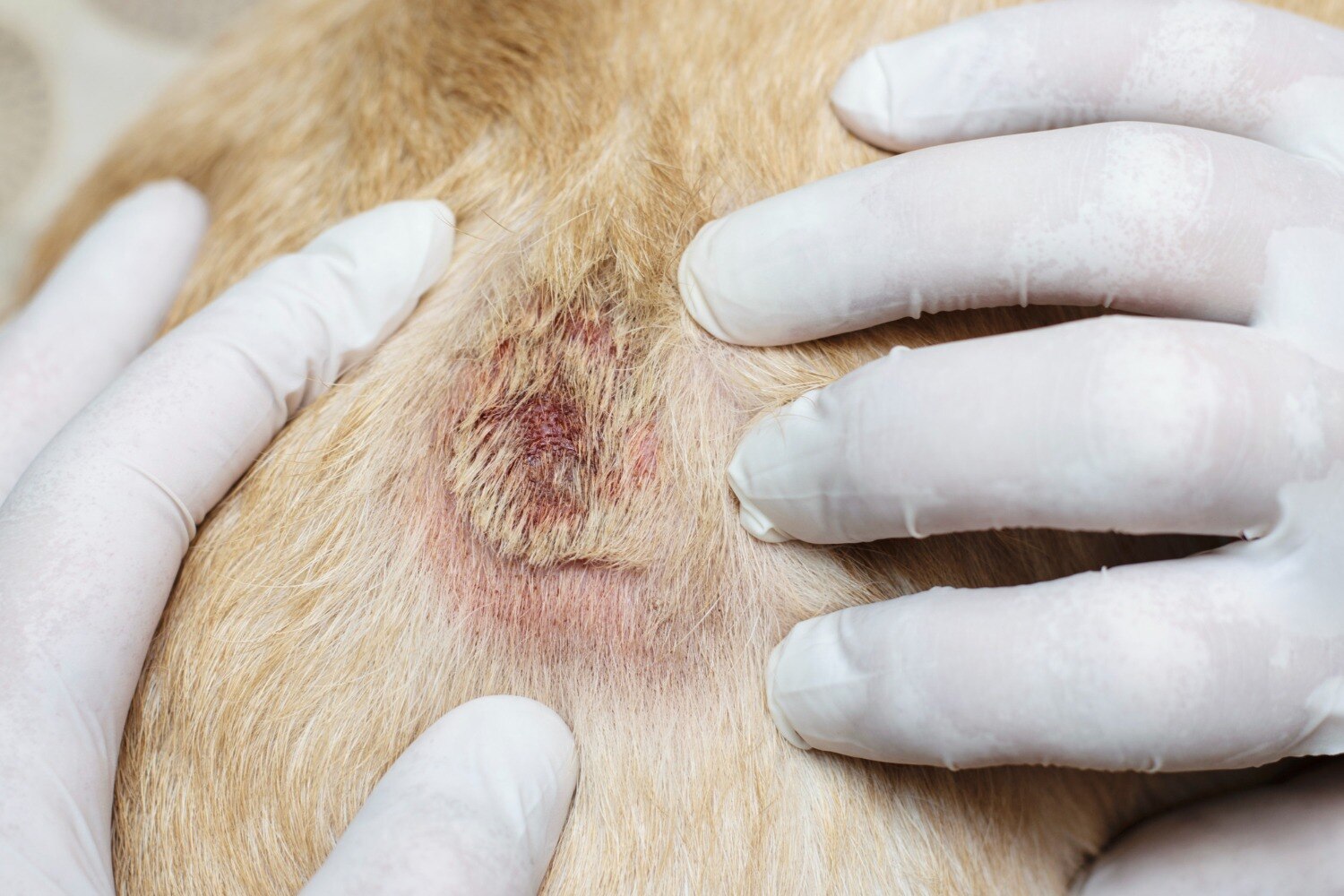
These signs are not minor grooming issues. Ear scratching, head shaking, odour, discharge, or pain can indicate otitis externa linked to the same allergic or infectious process, while redness, grease, pustules, scabs, and crusts can signal bacterial or Malassezia yeast infection.
The underlying trigger still needs investigation, because fleas, mites, allergies, and other diseases can occur together.
What the itch pattern can reveal about its cause
Lower-back and tail-base itching points toward fleas or flea allergy dermatitis, but location alone cannot confirm a diagnosis. Grooming can remove every visible flea, while flea dirt remains as dark specks that turn reddish-brown on a damp white tissue.
| Cause | Common clue | Important limitation |
|---|---|---|
| Fleas or flea allergy dermatitis | Intense itching over the lower back and tail base | No visible flea does not rule it out |
| Mites and other parasites | Severe itch, crusts, hair loss, or spread between animals | Skin scraping or other testing may be needed |
| Environmental allergy | Face, ears, paws, armpits, groin, or underside affected | These sites overlap with infection and food allergy |
| Bacterial infection or Malassezia yeast | Redness, odour, greasy skin, pustules, crusts, or recurrent ear disease | Infection may be secondary to allergy or parasites |
| Ringworm | Scaly patches or broken hairs | It can spread to people and needs fungal testing |
To investigate food allergy, feed only a veterinary-selected novel-protein or hydrolyzed-protein diet for about eight weeks. Exclude treats, table food, flavoured medicines, and another animal’s food, then use a controlled rechallenge; improvement alone does not prove food allergy.
Hormonal or autoimmune disease and pain-related licking remain alternatives. More than one cause can occur together, so a steroid response or an itch pattern cannot establish the diagnosis.
What to record before the skin examination
Before the appointment, record the exact onset, affected body areas, changes in intensity, seasonal pattern, sleep disruption, and ear symptoms. Note diet changes, new shampoos or cleaners, the parasite-prevention product and application date, contact with other animals, travel, and every previous medicine.
- Photograph flare-ups before cleaning the skin or applying any product, using the same lighting whenever possible.
- Bring medicine packages or clear names, doses, and dates, including products that helped only briefly.
Expect a detailed history and examination of the entire skin, ears, paws, nails, and body surface. Appearance alone can miss mites, infection, or otitis. At Pet Care Hospital- Best Pet Clinic in Dwarka, ask how each proposed test changes the treatment plan before choosing treatment based only on what the rash looks like.
| Test | What it checks | When it helps |
|---|---|---|
| Flea combing | Fleas or flea dirt | Flea allergy is possible, even without visible fleas |
| Skin cytology | Bacteria, Malassezia yeast, and inflammation | Redness, odour, greasy skin, pustules, or crusts |
| Skin scraping | Mites and other surface parasites | Severe itch, crusting, or hair loss |
| Fungal testing | Ringworm | Scaling, broken hairs, or possible spread to people |
| Ear cytology | Organisms and inflammation in ear debris | Head shaking, discharge, odour, or painful ears |
| Allergy evaluation, blood tests, or biopsy | Allergy patterns, systemic disease, or unusual lesions | First-line tests and history do not explain the problem |
Related service
Veterinary Dermatology & Skin Care Veterinary Dermatology & Skin Care At Pet Care Hospital with Dr. Satish, veterinary dermatology focuses on keeping your pet’s skin and coat healthy, comfortable, and free from... View service → |
Why treatment must match the confirmed or suspected cause
A red rash is not a diagnosis, so treatment must target the confirmed or suspected cause. Treating only the visible irritation can suppress signs while the trigger continues, allowing self-trauma, secondary infection, and a harder-to-recognise original problem.
A brief response to a steroid or other anti-itch medication does not prove allergy and can hide infection or parasites.
A cause-directed plan may include:
- Flea or mite disease: use appropriate parasite control for every in-contact pet and, for fleas, the home. Immature flea stages remain off the animal, so treating one pet alone can fail.
- Topical cleansing: use a clinician-selected product to remove scale, grease, allergens, or debris. Species and skin condition determine which cleanser is safe.
- Bacterial or yeast infection: add antibiotics or antifungals when testing identifies the infection, not merely because the skin is red.
- Itch relief: anti-itch medication can break the itch-scratch cycle, but the choice must account for species, age, other illnesses, and adverse effects.
- Suspected allergy: combine trigger avoidance, an exclusive diet trial when indicated, itch control, and possible immunotherapy. Blood or intradermal allergen tests help select immunotherapy allergens; neither test alone diagnoses atopic dermatitis.
- Underlying illness: treat hypothyroidism, Cushing’s disease, or another confirmed disorder alongside the skin problem.
Do not apply human creams, leftover antibiotics, steroid creams, or essential oils without veterinary direction. A product that briefly reduces scratching is not proof that it treats the disease.
What to do when treatment only helps briefly or the problem returns
An itch that returns after treatment calls for a recheck examination, not indefinite repetition of the same medicine. Arrange reassessment when recurrent itching, repeated ear infections, progressing hair loss, spreading lesions, or ongoing discomfort occurs despite following the plan.
At the appointment, the clinician can confirm whether parasites, bacteria, Malassezia yeast, or ear inflammation have cleared. The review should cover treatment response, missed doses, application errors, adverse effects, and whether tests such as skin or ear cytology, flea combing, or skin scraping support a revised diagnosis.
Before the visit, check these points:
- Do not keep using leftover antibiotics, antifungals, steroids, or anti-itch medicines without veterinary direction. A brief improvement can suppress signs while fleas, mites, infection, or allergy remains.
- If a food trial was prescribed, do not label the pet food-allergic because symptoms improved. An exclusive diet trial needs a controlled rechallenge to confirm the diagnosis.
- When fleas are involved, verify that every in-contact pet received the intended flea control and that household cleaning or environmental treatment was completed. Missing one host can restart the infestation.
- Request referral to a veterinary dermatologist when disease is severe, recurrent, diagnostically unclear, or unresponsive to an appropriate primary-care workup.
Ongoing treatment should follow the pet’s examination findings, test results, and treatment response—not the number of times a product temporarily reduces scratching.
Frequently asked questions
When does persistent itching need a veterinary appointment?
Book an appointment when itching continues beyond a few days, returns repeatedly, or worsens despite basic parasite prevention. Seek urgent care for open wounds, marked swelling, pus, severe pain, or breathing trouble.
What can an itching pattern reveal about its cause?
The body area affected, time of day, season, exposure history, and presence of hair loss, redness, scales, or discharge help the veterinarian narrow possible causes such as parasites, allergies, infection, or irritation.
What should you record before a pet skin examination?
Record when the itching began, where it occurs, how often your pet scratches or licks, recent diet or product changes, parasite prevention dates, other symptoms, and every treatment already tried.
Why must pet skin treatment match the cause?
Anti-itch treatment alone can hide symptoms while parasites, infection, allergy, or another condition continues. Confirming or narrowing the cause helps the veterinarian choose treatment and avoid unsuitable products.
What should you do if skin treatment only helps briefly?
Contact the veterinarian again instead of repeating the same treatment. Share the response timeline and any relapse signs so the diagnosis, treatment plan, parasite control, or follow-up examination can be reassessed.